Tuesday, 6 November 2012

Kashipur to Nepal and clearing Nepali immigration

The short piece of road from Indian immigration to the Nepali is a kind of no-mans land as no-one takes responsibility for it and, as a result, the road surface is worse than it was getting to Indian immigration


No-mans land


The immigration officials in the Nepali immigration were just as relaxed as their Indian counterparts and the process was just as easy. Waving them goodbye saying we'll see them tomorrow on our way back into India we set off to find customs so that we could declare our bike as there is a daily charge for taking a bike into Nepal. 


Our first new friends at Nepali immigration - looking for money of course, but they were chuffed with getting their photo taken instead. They were hooting with glee when I showed it to them on the camera.


Finally we found the custom's 'shed'. Here, it was that relaxed, they even offered you a cup of tea. Colin thought our bike was loaded with luggage because we have a tank bag as well as saddle bags. Had he loaded the bike like this one I would have been able to bring more than one change of clothes.

We set off on the 7kms journey to the border town and headed towards the Opera Hotel which both Indian and Nepali immigration officials had recommended, only because it has a bar and a casino I suspect). To be fair though we only seen one other guest-house on our way to town. It was a nice place and even everything in the room worked - hot water, TV, flushing toilet . Well, everything except the bathroom light which was nothing that Colin couldn't fix with a bit of gaffa tape.After having been to so many places in India where it was strictly vegeterian and alcohol free had we had a wee party to ourselves in the hotel - bottle of rum as it was all we could get, loadsa chicken and Saturday night football on the TV - magic!

Kashipur to Nepal and clearing Indian immigration

We set off from Kashipur and headed for Nepal. Our 1 year visa stipulates that we must leave India for 1 day every 180 day,s so if we crossed the border and stayed in Nepal for one night this would fulfill our visa requirements. We had decided to cross the border at the Indian town of Bombasa and stay in the border town of Mehendranagar in Nepal. On route we passed through many towns and we were held up several times due to train tracks running across the road hence having to stop as barriers were the down to allow trains to pass.

Once we reached the town the road surface on the main road was really poor as you can see in the video below


The road to Indian immigration

The last clip you see in the video where Colin beeps the horn and passes what looks like a load of white bags on the move is actually a bicycle laden with goods and a man pushing it at the side as there is no room for him to sit on it.


Then it was across the bridge to the Indian immigration office.


Colin sorting out the passport exit stamps while enjoying a wee chit-chat with the immigration officers. It certainly is a very relaxed border crossing and still uses paper ledgers. It would have been so easy to just drive past the immigration office as no one pays any attention to you but it's your responsibility to get your exit visa so you make sure you find it.


Other people crossing the border. Indian and Nepalese people don't need a visa to pass between the two and some people live in one country and go into the other country every day to go to work.


Some people cross on horseback in shared carriages.


Others load their bicycles with with goods and walk the bike through. They load them so much that they have to walk alongside the bike as there is no space for them to sit down.
After getting through Indian immigration and getting the much needed exit stamp in the passports we set off to find the Nepali immigration to get an entry stamp for Nepal.

Monday, 5 November 2012

Rishikesh to Kashipur

We were really enjoying being in Rishikesh so we stayed for 3 nights. The day before we left Rishikesh we walked into the main town as we knew there was an enfield mechanic there. After we had the problem with flooding the bike and losing power several times when we were riding to Rishikesh we had sent a text to our friends Jayne and Guy, who normally live in India but are in the UK at the moment, to check if we could have done any damage to the bike. Guy has had an enfield in India for 20 years and he told us to check and see if the spark plug was black and damaged. After looking at the internet to see what a damaged spark plug looked like, Colin decided that we did need a new plug and we managed to get one from the enfield mechanic. Unfortunately when we got it back to the hotel it didn't fit.

The following morning we loaded up the bike and eventually, after many attempts, got the bike started. We stopped at the mechanics on route and, looking as if we knew what we were taking about, told him he had given us the wrong plug. Surprise, surprise it was the correct plug and Colin hadn't been fitting it properly. Plug changed and red-faced again we set off. We also knew that the electrics on the bike - indicators, lights and brake lights - weren't working properly but we decided could get them fixed at a later date.

We had originally planned on leaving Rishikesh and riding back up into the mountain area to see places we hadn't been to but after reading the weather reports on our warm balcony in the hotel and discovering that the higher areas had been hit by icy winds, rain and snow we decided to abort that plan and remain on the plains where it was warm. So, we decided to head straight to Nepal to fulfill our visa requirements. We wouldn't get there in one day so would find somewhere on route to stop.


Shouting out to get directions to Kashipur

Most of our journey that day was on the national highway which was the usual good road surface mixed with really bad and quiet stretches of road mixed with very busy stretches, shouting out for directions when we came to a junction. Now we were out of the mountains and at a low altitude the weather was lovely and it was really interesting driving through rural India, watching the changing countryside and landscape.


Modes of transport changes to horses, cows and water buffalo.


These vehicles that look like they should be in a Mad Max film. They are used as shared transport, almost like a bus.


Enjoying a break while posing for a photo.


These horse and carts are also a shared transport.


A cycle rickshaw.


Even in rural India vehicles coming towards you always overtake, even when it just about runs you off the road. Because this bus was coming straight towards us in our lane we had no choice but to swerve off the road. The same rule always applys - the bigger you are the more right of way you have!


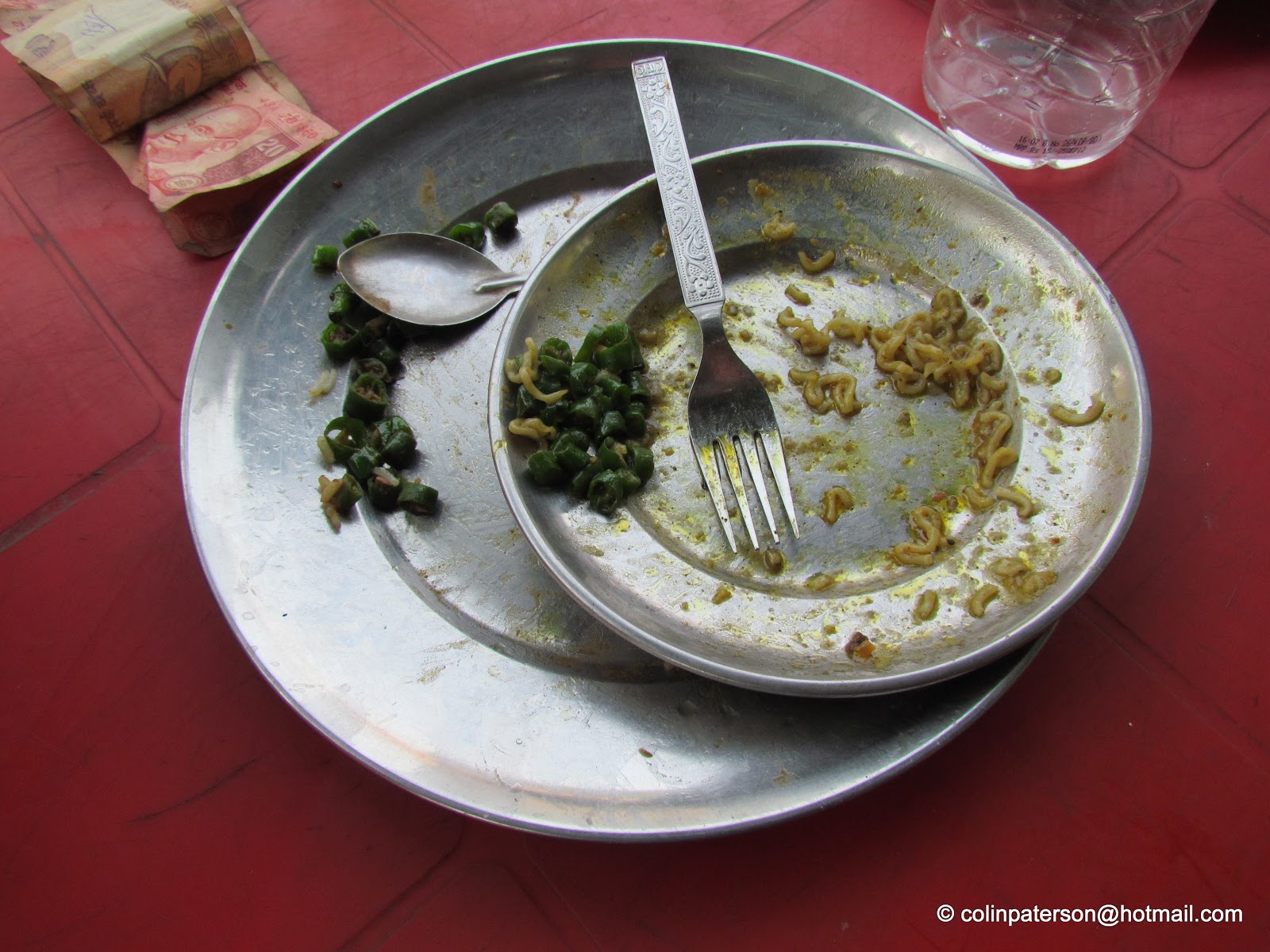
Lunch was the usual food in a road-side dhaba, omelette noodles and dhal. This cook certainly had a green chilli fetish, and these chillis were only the ones that we managed to dig out, the rest ingested.

We arrived at a town called Kasipur and as time was getting on we decided to get a room for the night. We knew the first hotel that we stopped at would be well out of our price range but we thought we would try our luck. They were really nice and even phoned the manager at home to see if they could give us a room at a much cheaper rate. Permission denied they told us how to get to a hotel - Hotel Premdeep International - that was within our price range where we managed to get a room. This helpfulness is really common in India.


Rama Festival in Rishikesh

When we arrived in Rishikesh it was the 7th day of the 9 day festival of the Hindu God, Lord Rama . Rishikesh is normally a bustling place but because of the festival it was packed. There were parades on the streets, dancing, Ashrams chanting loudly, paint throwing (this is the Hindu tradition of throwing coloured powder and water, not just at one another but also at any passing strangers) etc. It is all taken in good humour and no-one seems to mind being covered in coloured gunge).


On the last day of the festival, people waiting at the boom of the Ghats for the Gods to arrive.


The festival in full swing with paint being thrown all around.


Now covered in coloured powder, The Gods are taken down to the Ganges


The God (sitting in the fancy chair) being guided into the water.


Parades in the street. This guy is dressed as the Indian God Hanuman.


Effigies are burned to depict the triumph of Lord Rama over Ravana , which is seen as good over evil. It was set on fire at night after a fabulous fireworks display. Hundreds of people were at the Ghat for the burning but hundreds more were stood on the suspension bridge. Initially we were standing on the bridge but soon decided to get off it as we thought there was a heck of a lot of people to be supported by one bridge, but luckily the bridge held! It certainly wouldn't have been the first bridge to collapse in Asia.


The streets were covered in powder.


The musicians who had been playing drums and blowing trumpets for days were glad of the rest I think.


The stage in this video was set up throughout the festival and blasted out 'music' all night. Our hotel wasn't too far from it. We had to keep our bathroom door closed when the stage was in full swing as the sound seemed to gather in there and going for a pee was like walking into a boogie box! Make sure the volume is up when you listen to the video and see if you can last the short 36 seconds.

Saturday, 3 November 2012

Our 3 night stay in Rishikesh


Rishikesh is a small religious town in the northern state of Uttarakhand on the River Ganges , where the water is believed to be holy water by the Hindus. The centre of the town is really hectic and busy and not the reason why travellers to go to Rishikesh. Further on from the main town are 2 suspension bridges that span the ganges, one at a place called Ram Jhula and the other at Laxshman Jhula. When you cross either of theses bridges you reach the part of Rishikesh that is of interest to most travellers. This is known as the world capitol of yoga and has many Ashrams  where Hindus and travellers alike go and stay. It is a really bustling place with good eateries and shops selling all the usual travellers clothes, jewellery, crafts such as thankas  etc. This photo is taken from our balcony looking over the River Ganges to that part of the town.


 The Ghats  leading down to the River Ganges. Ghats are a set of stairs that lead down to a holy river which people use to walk down to the river to bath in the holy water, perform religious rites or Hindu cremations. Although all Ghats are used for bathing and religious ceremonies not all are used for cremations. We never seen any evidence that these particular Ghats are used for cremation.


The bridge at Laxshman Jhula. It's always really crowded and we decided it was better not to take the bike across. People do, but it's just crazy trying to fight your way through.


There are monkeys galore around the bridge swinging around playing on the high bridge cables like the one in the photo or just sitting around on various parts of the bridge.


You need to be careful if you have any food on your possession as they are not scared to take a grab at you to get at the food. This Indian lady in front of us freaked when a monkey grabbed at her but by the look of the monkeys' chops with a nut in them, it must have got what it wanted.


The other suspension bridge at Ram Jhula, which is the least busy of the two.


A Baba looking out to the River Ganges.


An entrance to Ashram and Ghats.


A statue of the Hindu God Shiva


A statue of the Hindu God Hanuman , the Monkey God.


Colin buying small hand-made biscuits. They are served hot and taste kind of like shortbread with sesame seeds on top. He had been raving about them before we got to Rishikesh as he had loved eating them on previous trips.


Babas sitting chatting.


Women and children sitting by the River Ganges.


The River Ganges at sunset.
Posted by Picasa

Friday, 2 November 2012

Paonta Sahib to Rishikesh

We left Paonta Sahib to head to Rishikesh. After our detour yesterday that ended up landing us in Paonta Sahib we reckoned we only had about a 2 hour drive along the national highway. We knew that before long we would have to stop for petrol but we wanted to give the bike a good run first to let it warm up. It takes a fair amount of time to get the bike started in the morning, and Colin has groin strain with all the kick starting that he has to do, so the last thing that we wanted was to stop too early and then not get going again.

Well, I thought that was the last thing we wanted but worse can happen. We hadn't gone that far when the bike lost power and came to a halt. We had ran out of petrol. Luckily we carry a spare litre of fuel so we put it in the tank and set off again. About 1km down the road we lost power again. We were both stood at the roadside just looking at the bike with not a clue between us. An Indian guy came over to help. He wiggled a few things and the bike started again. When we asked him what he had done he said that he didn't know. So much for a tutorial.

Off we set just to lose power again 1km later. We were just outside a petrol garage and at least filled up with petrol - at least we know how to do that! We asked where the nearest mechanic shop was and Colin set off to find it. When he got to where he was told to go there was no mechanic shop and he was told to go somewhere else. When he got there, there was no mechanic shop. After a few similar episodes he gave up and came back to the bike. It miraculously started again only to lose power again, this time on a hairpin bend with vehicles all over the place. Once again we got it started and decided to keep going until we spotted a mechanics. Colin then realised that the choke was out and that the engine was constantly flooding. In future we won't forget to put the choke back in after we start the bike in the morning.

On route we passed through the city of Dehradun, the capitol city in the state of Uttarakhand. It has a population of about half a million and is the biggest city we have driven through so far. It was mental driving and the road bore no resemblance to what was on the map. The map showed one road that ran the length of the city but in actual fact there was major junction after major junction. We had to shout out to people at every junction to find our way, while still driving. Often we just rode up beside someone else on a bike and shouted over to them. We were very relieved and pleased to leave Dehradun behind and take the mountain road the last 14 miles to Rishikesh.

We hadn't gone far when we came across a road sign 'DANGER, BEWARE OF WILD DANGEROUS ELEPHANTS' and a picture showed a car being overturned in the road by a huge elephant. We thought it was quite funny until we kept seeing the same sign every couple of hundred metres. That was all we needed - death by elephant. Fortunately we didn't encounter one but the road was potentially lethal as there scores of monkeys all over the place - tiny little ones and rather large ones!

On route we also passed an Emu Farm and we never knew these existed in India. It ended up taking us 4 hours instead of 2 hours to reach Rishikesh. It only has an altitude of 372m and was really hot. We had shed a few layers of clothing. I had started off the journey with thermal top and long johns, a t-shirt, a lightweight fleece and a heavy weight fleece jacket, trousers and big woolly socks and gloves.

We found a really nice guest house in the Lakshman Jhula side of Rishikesh in Nigah Tourist home with a balcony overlooking the River Ganges.

Shimla to Paonta Sahib


A Road on Route

We when we were leaving Shimla we realised that our horn wasn't working - doesn't matter if your lights, break lights, indicators etc don't work as most people don't use these or pay any attention to anyone who does use them - but a horn is essential. We found a small garage and told the mechanic that we needed a new horn fitted. He took one look at it and just pressed the connection in properly. We looked like a pair of divvies who obviously knew nothing about bikes. Horn working and red faced we set off.

The next place we wanted to get to was Rishikesh but again it was going to take us 2 days to get there so we would need to stop and stay somewhere the first night. We decided to aim for a place called Renulka Lake that we had read about. It would mean taking a detour but we were cool with that as we still had plenty of time before we had to be in Nepal.

We rode on the national highway for a while and then took a lesser road. The road was about 70kms long and initially it was a great road to ride. The sun was out and and we were really enjoying it. We couldn't believe there was so little other traffic using the road. Soon bliss turned to bone-rattling and we realised why there were very few vehicles on that road. Very abruptly, after about 20kms, the black-top disappeared and was replaced by rubble and rocks. It was like quad biking without a quad bike. Colin used to do a lot of mountain biking and thought it was like mountain biking for lazy gits because we had an engine. Difference being was that Colin was trying to control 180kilos, plus our weight, over that terrain. It took us 3 hours to cover 50kms of that road surface and we were glad to get off it. The photo above is a wee pit stop that we made when we found 1km of the road where the surface of the road was in relatively excellent condition.

At the end of it our bones were rattling and time was getting on. We decided that we still had enough time to get to Renulka Lake before dark so off we headed. We drove through a small town and came to a junction which of course wasn't on the map, which seems to be the norm when you hit any cities or towns. I shouted out to 2 teenagers and asked the way to Renulka. They pointed left and off we went. I jokingly said to Colin that maybe they were taking the mick because they were laughing when I shouted out to them. Athough overall Indian people are very helpful and, in fact, if you stop at the roadside for a pit stop people will pull over in their cars and bikes to ask you if everything is OK or if you need some help, something didn't seem right because the 2 boys were laughing. At that point I should have trusted my instincts. 

45 minutes later on the road, not having seen any houses or other vehicles and the road be coming bumpier and narrower Colin had said a few times that he thought maybe we weren't on the right road. Then finally we saw an Indian guy on a bike. We asked him how far it was to Renulka Lake as it was 5pm and we didn't want to be on the road much longer, but we had guessed the answer before he told us. He just looked at us and pointed back the way we had just come. When we asked where this road led to he said nowhere.

Words were uttered, which can't be repeated, as we had no choice but to head back. By the time we got to the national highway it was dark. Normally on the highways you find hotels along the way but not this one. We were cold and tired but had to keep driving - hoping to spot potholes and other potential disasters on time.

Finally a hotel appeared - Hotel Holiday Resorts - and we were really relieved. Considering, at the point, we would probably have paid anything to get a place to sleep I had the cheek to go in and and haggle over the price. It was the usual basic but clean hotel. It had a restaurant but no menu, despite offering conference and banqueting facilities! However the guy managed to russle us up some tastey food. Oh well, at least in the morning we would be nearer Rishikesh.

Some images of the lake that we may have seen if we had got there, instead of having to stay in a highway hotel 10kms from a place called Paonta Sahib  RENULKA LAKE
Posted by Picasa